Water Mitigation After Tornado Related Roof Damage in Tulsa
A tornado opens your roof, then the rain does the rest. Here is how water mitigation after tornado roof damage in Tulsa actually works, step by step.
Water mitigation after tornado roof damage in Tulsa is the process of stopping the water, extracting what has already come in, and drying the structure before mold takes hold. It has to start within 24 to 48 hours of the storm, because wind-driven rain that enters through a torn roof deck reaches ceilings, insulation, and wall cavities long before you see a stain. This post walks through what happens in the first hour, how the mitigation itself works, what insurance covers, and the mistakes that turn a $3,000 repair into a $30,000 rebuild.
Why Tornado Roof Damage Turns Into Water Damage So Fast
A tornado does not just remove shingles; it breaks the building envelope, and once the envelope is open, every drop of rain that follows has a direct path into your home. Tulsa sits in the heart of Tornado Alley, and our spring storm season runs from late March through June, with a secondary severe-weather window in October and November. That timing matters, because the same supercells that spawn tornadoes drop 1 to 3 inches of rain in under an hour.
Three things happen at once when a roof is compromised. First, wind-driven rain pushes sideways under lifted shingles and into attic vents, so water enters in places that look untouched from the ground. Second, missing decking exposes the attic floor, insulation, and the top plates of your walls. Third, water follows gravity down through ceiling drywall, which acts like a sponge and can hold several gallons before it sags or drips.
By the time you see a brown ring on the ceiling, the wet zone is usually two to three times larger than the visible stain. That is why we treat every tornado roof leak as a structural drying job, not a bucket-and-towel job.
What to Do in the First Hour After a Tornado Damages Your Roof in Tulsa
The first hour after a tornado damages your roof in Tulsa is about safety and stopping the spread, not cleanup. Do these in order:
- Get out if the structure is compromised. Cracked rafters, a sagging ceiling, or a smell of gas means leave and call from outside.
- Kill power to wet areas. If water is anywhere near outlets, ceiling fixtures, or the panel, shut off the breaker for those circuits.
- Document everything. Photograph the roof damage from the ground, then every wet ceiling, wall, and floor inside. Timestamped photos are the backbone of your insurance claim.
- Contain the drip. Move furniture, electronics, and rugs out of the wet zone. Do not walk on a sagging ceiling to place a bucket; use a tarp on the floor instead.
- Call for tarping and water removal. A tarp on the roof stops the next round of rain, and extraction starts the drying clock.
Do not run a household fan and call it drying. A box fan moves surface air; it does not pull moisture out of insulation or wall cavities. We bring commercial dehumidifiers and air movers that drop the relative humidity in a closed room from 70 percent down to 40 percent or lower, which is where structural materials actually release water.
How Water Mitigation After Tornado Roof Damage Tulsa Works, Step by Step
Water mitigation after tornado roof damage Tulsa crews perform follows a fixed sequence, and skipping a step is how mold gets a foothold. Here is the order we run on every storm job.
1. Emergency tarping and roof stabilization
We tarp the damaged sections to stop additional rain from entering. A 20x30 tarp covers most single-family roof penetrations, and we secure it with battens so 40 mph gusts do not peel it off overnight.
2. Emergency water extraction
Standing water comes out first. Truck-mounted extraction units pull water from carpet, pad, and hardwood at a rate of 10 to 15 gallons per minute. In a typical Tulsa home with a soaked living room and hallway, that is 45 to 90 minutes of work.
3. Moisture mapping
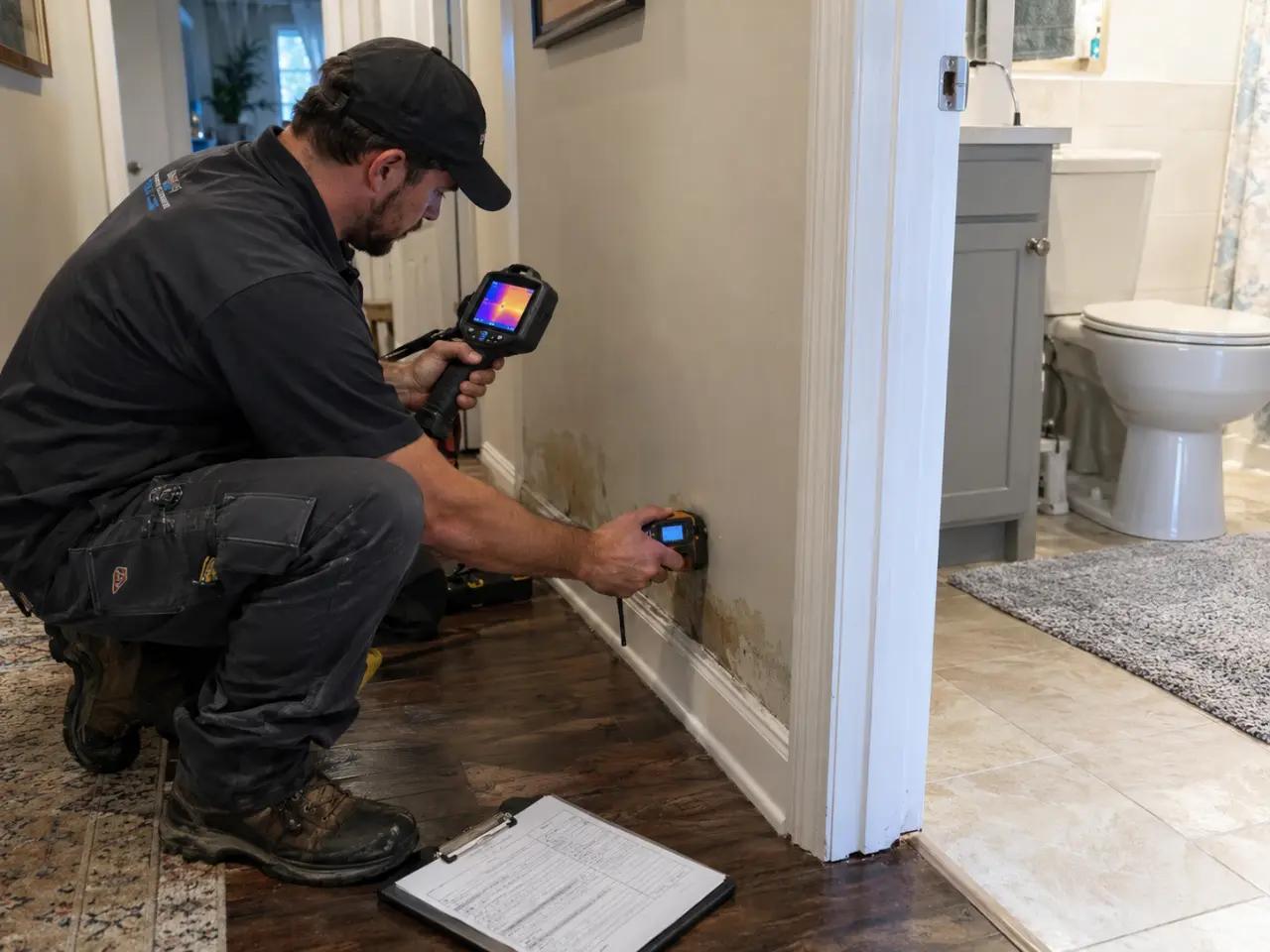
We use thermal imaging and pin-type meters to find the wet zones behind walls and above ceilings. This is where we routinely find water 6 to 10 feet from the visible leak, because it traveled along joists and top plates.
4. Structural drying and dehumidification
Air movers and commercial dehumidifiers run continuously for 3 to 5 days on a typical tornado roof leak. We check moisture readings daily and do not pull equipment until affected materials read within 2 to 4 percentage points of a dry reference sample.
5. Antimicrobial treatment and content protection
Any wet porous material that cannot be dried in place, like ceiling drywall or saturated insulation, gets removed. We treat exposed framing with an antimicrobial to slow microbial growth while the structure finishes drying.
If the storm also pushed water into a below-grade space, we handle that separately with basement water removal Tulsa, because basement drying needs different airflow and a sump check.
How Soon Should Water Mitigation Begin After Storm Damage?
Water mitigation should begin within 24 hours of storm damage, and no later than 48 hours, because mold can begin colonizing wet drywall and insulation in as little as 24 to 48 hours in Oklahoma's humid spring air. After 72 hours, the odds of visible mold growth climb sharply, and remediation costs jump from drying to demolition.
Here is what the clock looks like in practice:
- 0-24 hours: extraction, tarping, and drying equipment on site. Best-case scenario for saving drywall and flooring.
- 24-48 hours: drying still works, but expect more material removal, especially ceiling drywall and insulation.
- 48-72 hours: mold risk rises, and we add antimicrobial treatment and air scrubbing to the scope.
- 72+ hours: remediation, not just mitigation. Walls come out, and the job gets longer and more expensive.
We run 24/7 during storm events because the difference between a Tuesday night call and a Thursday morning call is often thousands of dollars.
Does Homeowners Insurance Cover Water Damage From a Storm-Damaged Roof?
Homeowners insurance covers water damage from a storm-damaged roof in most Tulsa policies, because the water entered through a sudden, accidental opening created by wind or hail, not through neglect. The key distinction insurers make is between the cause of the opening (covered wind damage) and the resulting water intrusion (usually covered as a consequence).
What typically gets covered:
- Roof repair or replacement for the wind-damaged portion
- Emergency tarping and water extraction
- Structural drying, dehumidification, and equipment rental
- Replacement of damaged drywall, insulation, flooring, and personal property
- Mold remediation when it is a direct result of the covered storm loss
What usually does not get covered: long-term leaks you knew about and ignored, and water that entered through a maintenance issue rather than the storm. Document the storm date, keep every receipt, and let us provide the moisture readings and photo log your adjuster needs. We bill most major carriers directly and can walk your adjuster through the drying log line by line.
Common Mistakes We See After Tulsa Tornadoes
Common mistakes after Tulsa tornadoes turn a manageable water loss into a mold and structural problem, and almost all of them happen in the first 48 hours. These are the ones we see on nearly every storm call.
- Waiting for the roofer before calling a mitigation crew. The roofer fixes the roof; we stop the water. Those are two different jobs, and the water clock does not wait for the roofer's schedule.
- Assuming the leak is only where the stain is. Water travels along framing. We routinely find wet insulation 8 feet from the visible ceiling spot.
- Running a shop fan and calling it dry. Surface airflow does not dry wall cavities or insulation, and it can spread mold spores if growth has already started.
- Throwing away wet items before documenting them. Your adjuster needs photos and, for high-value items, an inventory before disposal.
- Ignoring the attic. Tornado roof leaks soak attic insulation, which then holds moisture against the ceiling drywall for weeks.
One more: do not sign anything from a storm chaser who shows up in an unmarked truck the day after the tornado. Ask for a local address and a written scope before anyone touches your roof.
When to Call a Professional
Call a professional when water has reached the ceiling, walls, or insulation, when more than about 10 square feet of flooring is wet, or when the roof opening is larger than a shingle or two. Those are the thresholds where household equipment stops working and mold risk starts climbing.
Our team at Tulsa Water Shield handles the whole sequence: emergency tarping, water extraction, structural drying, and mold prevention. We serve homeowners across the metro, and we know how differently storms hit each neighborhood. In Water Mitigation in Brookside, for example, the 1920s bungalows have original plaster walls that hold moisture far longer than modern drywall, so we extend drying times and monitor those walls daily. In Water Mitigation in Midtown, the mix of older housing stock and mature tree canopy means more roof penetrations from limbs, and we often find water in two or three rooms from a single impact point.
If you are not sure whether your situation needs a pro, call us and describe what you see. We will tell you honestly whether it is a bucket-and-fan situation or a drying job.
Frequently Asked Questions
What should I do if a tornado damages my roof in Tulsa?
Get everyone safe, shut off power to wet areas, photograph the damage, and call for emergency tarping and water extraction within 24 hours. Do not walk on a sagging ceiling or wait for the roofer before starting water mitigation, because mold can begin in 24 to 48 hours.
How soon should water mitigation begin after storm damage?
Within 24 hours, and no later than 48. Mold can start colonizing wet drywall and insulation in as little as 24 to 48 hours in Oklahoma's humid spring air, and after 72 hours the job shifts from drying to demolition and remediation.
Does homeowners insurance cover water damage from a storm-damaged roof?
Yes, in most Tulsa policies. When wind or hail creates the roof opening, the resulting water damage is typically covered as part of the same claim, including extraction, drying, and damaged contents. Long-term leaks you ignored are usually excluded.
Can a water mitigation team help prevent mold after a tornado?
Yes. Fast extraction, commercial dehumidification, and daily moisture monitoring drop material moisture below the threshold where mold grows. We dry affected materials to within 2 to 4 percentage points of a dry reference sample before we pull equipment, which is the standard that prevents mold.
Who offers emergency roof leak water cleanup in Tulsa OK?
Tulsa Water Shield offers 24/7 emergency roof leak water cleanup in Tulsa OK, including tarping, extraction, structural drying, and mold prevention. We bill most major insurance carriers directly and serve the entire Tulsa metro, including Brookside, Midtown, and surrounding neighborhoods.
Get Help With Water Mitigation in Tulsa
If a tornado opened your roof and rain is coming in, the clock is already running. Our team provides Water Mitigation Tulsa OK around the clock, from emergency tarping and extraction to full structural drying and mold prevention.
Call (918) 848-9096 now and we will get a crew moving toward your home.